Playable prototypeBuild · Explore · Endure
Every empire is a civilization.
Choose your monarch, find a home for your people and build a kingdom. When the light fades, the Rot advances. Every coin is a choice.
- No installation
- Keyboard, controller or touch
- PT / EN
Chrome, Edge, Firefox or Safari · about 19 MB the first time
On this touch screen you play with your fingers: phone held sideways, the stick on the left and the buttons on the right.
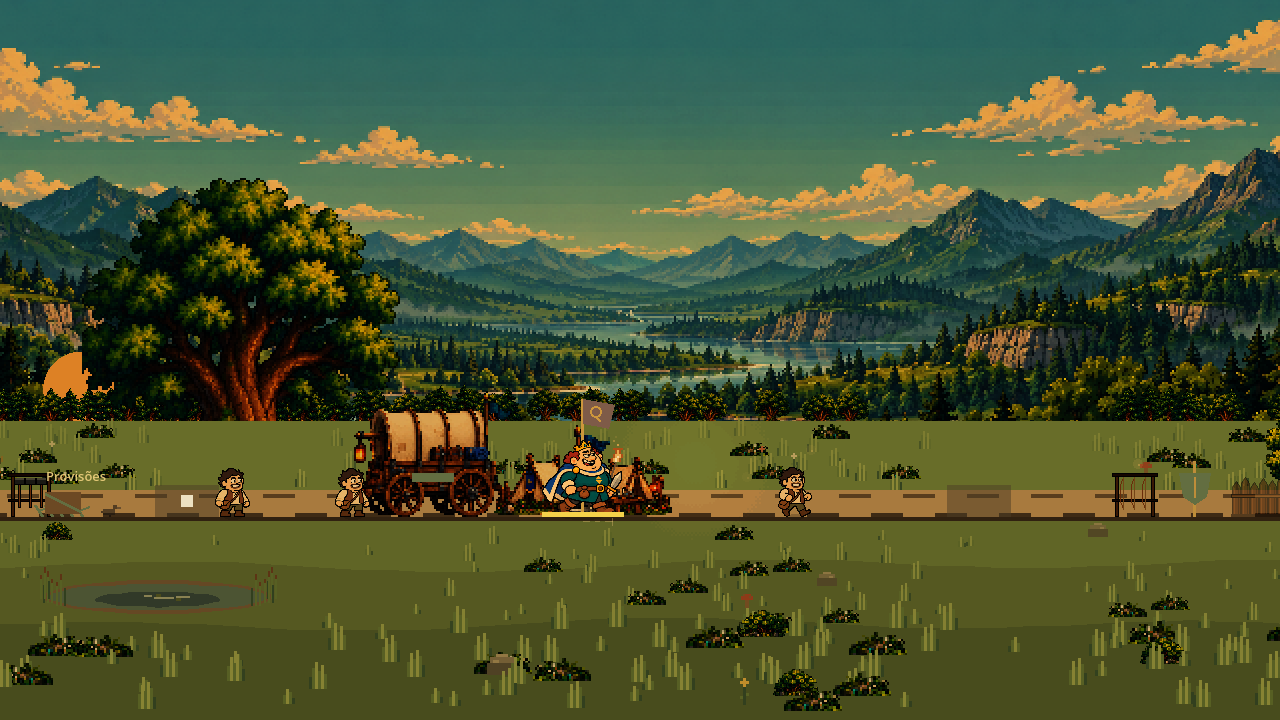
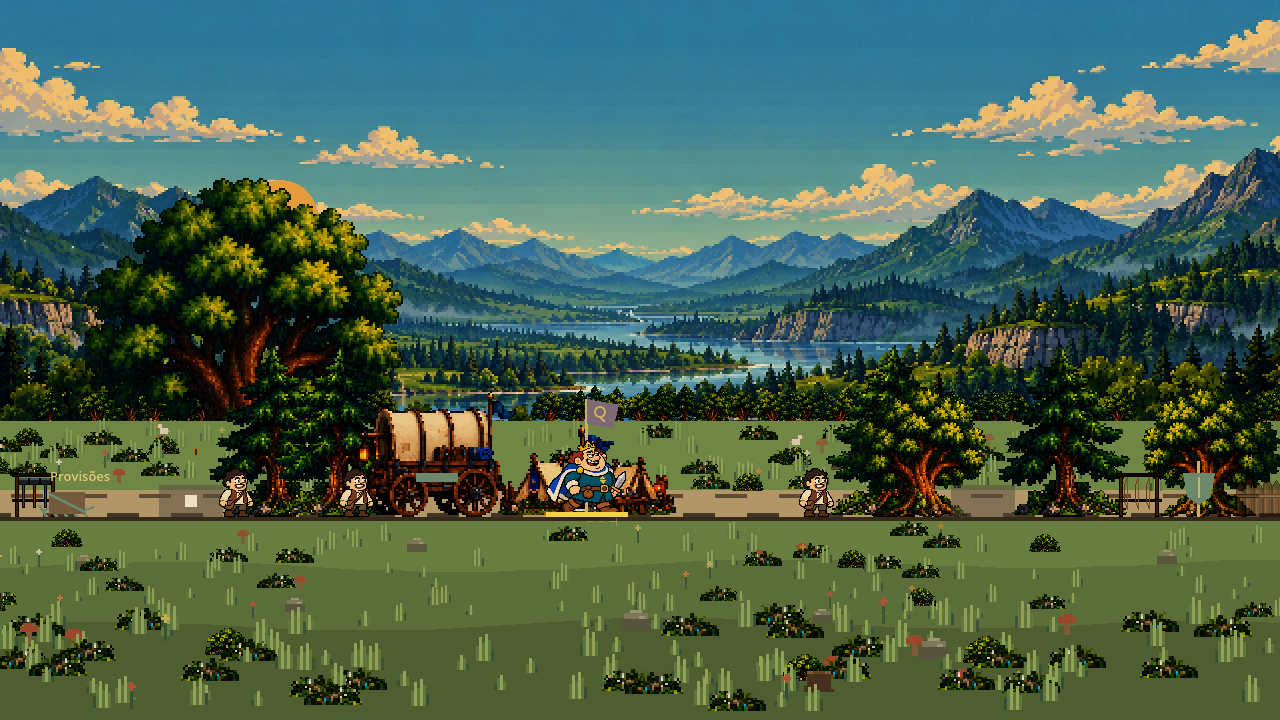
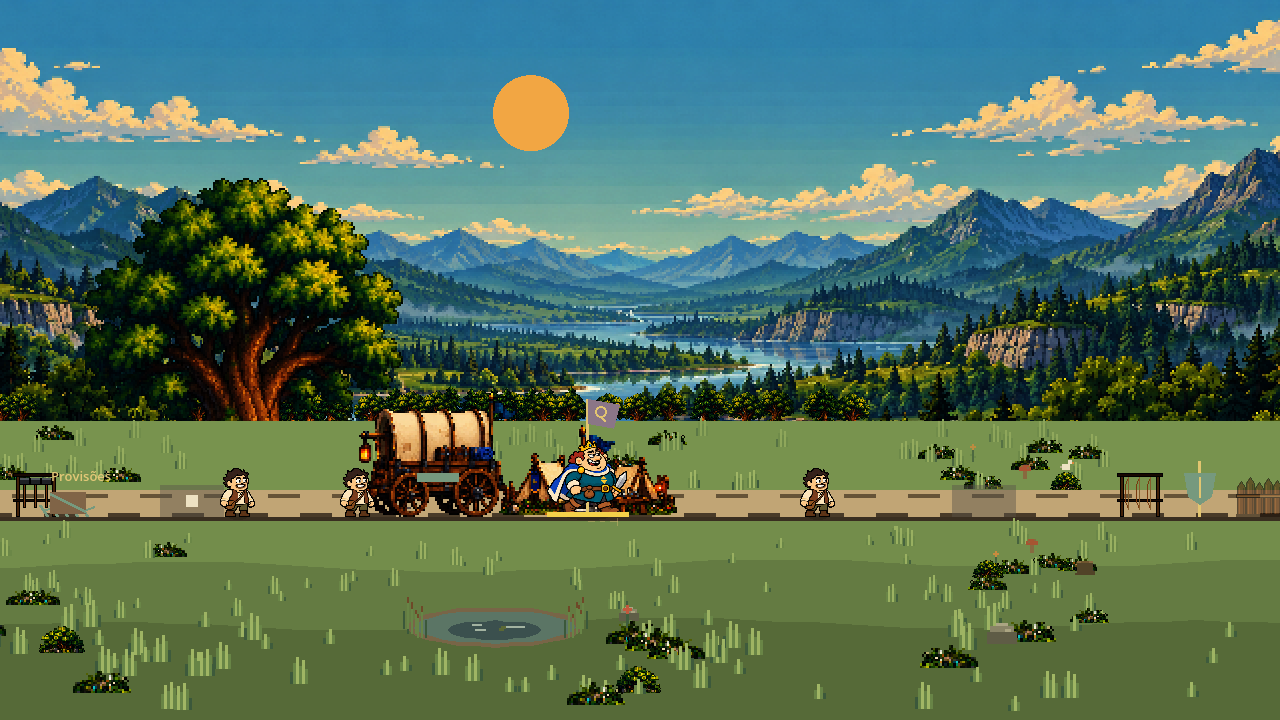
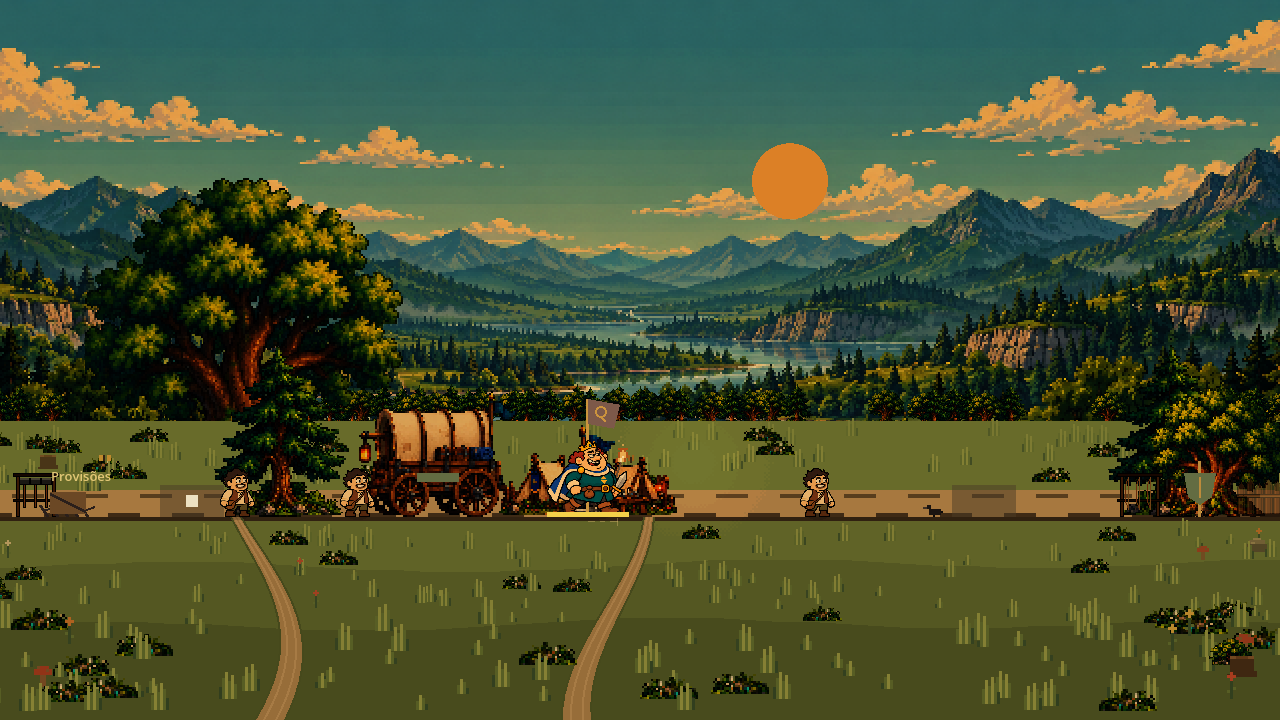
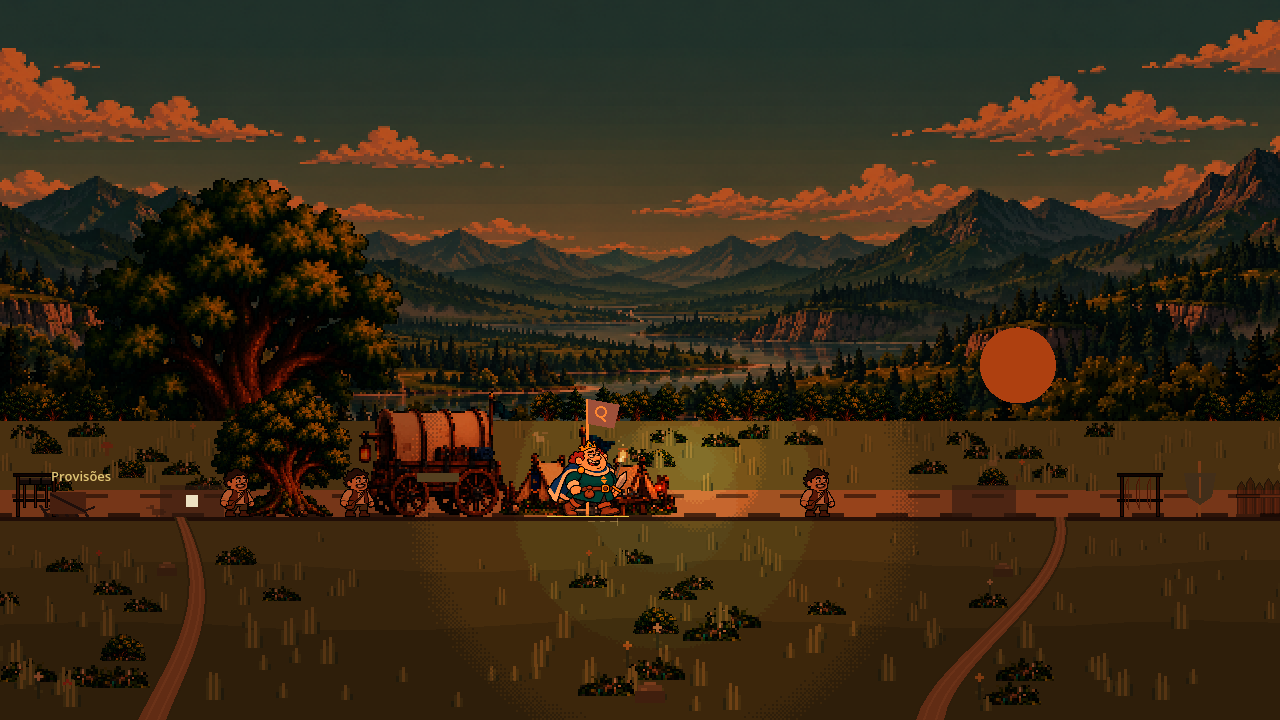
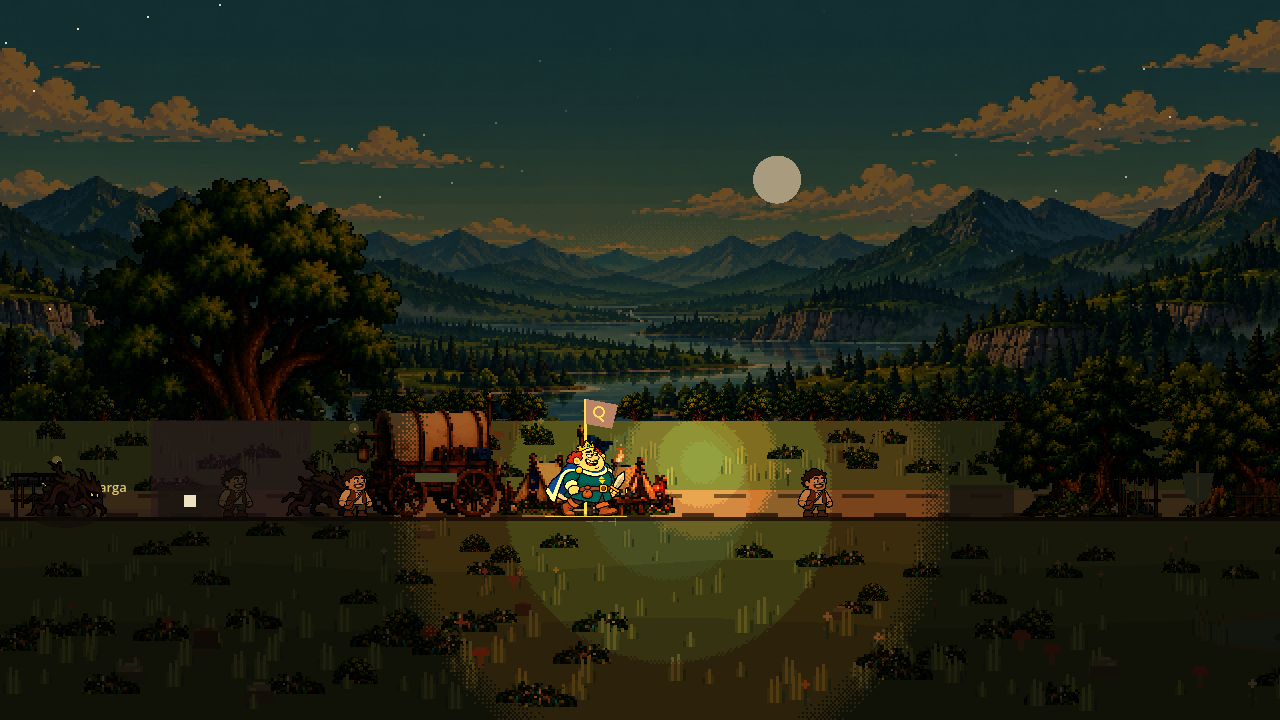
Start here
Your first day in the kingdom.
Choose your monarch
Each monarch has a weapon and a companion. Try the play style that suits you.
Explore and settle
Your caravan follows you. Find your place and confirm the settlement before you start building.
Prepare for the first night
Spend coins to recruit and build. Return to the safety of your kingdom as the light begins to fade.
A prototype in development. Progress stays in this browser.
Report a problemThe game
A kingdom on a line, with a floor above and a floor below.
Empire is played side-on, like Kingdom — and it's what happens when every region is home to different people, the night has a will of its own and the ground has a basement. These are the five pillars of the design; what you can already play is further down, counted.
Every empire is a civilization
Terrain shapes architecture, which shapes the economy, which shapes defense. By the end, your empire is a visible collage of everything you absorbed — readable on a single screen.
Every subject is someone
The fat king with the crooked crown, the squire in the oversized helmet, the mustached smith. Nobody has a name until they earn one, and death is permanent.
The world has a downstairs
Beneath the landscape there are cellars, a secret room under the castle and dungeons in the ruins — places with walls, born the first time you go down.
Loyalty is a currency
Enemies become allies and allies become enemies. The bard charms, the diplomat assimilates, mercenaries sell out to the highest bidder — and they collect.
The night is a character
There are no waves. There is the Rot: a stain born beside its Lume that advances across the land and retreats with the day. Your fires push it back or slow it down. You look at the horizon and you know how much time you have.
The monarchs
Who will rule your realm?
Choose your monarch. Each fights, rules and explores in their own way, and brings a companion who serves for coins.
-
Monarch 1
King
Guards the line and rules near it
- How they play
- Heavy and slow, a short weak blow. Nearby troops gain +10% defence. The safest choice, if the shield is paid.
- Companion
- The squire: give coins to arm the shield that protects you; with coins dropped by enemies they earn a sword.
- Evolution
- To be decided: the requirement is still a proposal awaiting approval.
-
Monarch 2
Empress Nia
Fights fast and pays for the Bard's support
- How they play
- Small and fast: many short, light blows. Your Bard charms weak creatures to fight for you for a while, or spurs your people to move faster.
- Companion
- The Banner Bard: sings only alive, beside you and paid — give coins, or pay each song from your purse.
- Evolution
- To be decided: the requirement is still a proposal awaiting approval.
-
Monarch 3
Archer Emperor
Strikes from range and wears targets down
- How they play
- Long-range arrows that sometimes make the target bleed. Mark an enemy for your troops to focus fire. The quiver runs out: each shot spends an arrow.
- Companion
- The quiver squire: sells you arrows for coins from your purse. No coins, no new arrows; the ones you carry still serve.
- Evolution
- To be decided: the requirement is still a proposal awaiting approval.
Every monarch rules, every monarch may explore, and every monarch can die. Only emperors are played: troops, crafts and companions act on their own. Pay your companion with E / X beside them.
The text is the game's own choice screen (strings.csv), with each class's numbers from classes.csv — read on every publish. Anything that depends on a number still under proposal is left to be decided.
Day and night
A day lasts 360 seconds. You never need to look at a clock.
Each phase has its own job, sound and light, and none can be mistaken for another. The night is brown, not blue — which is why, at night, only two colors break from the earth: its violet and your amber.
-
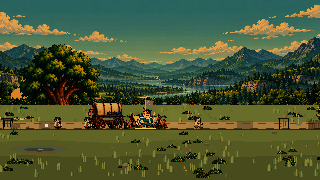
Dawn 15 s
The bell rings. The Rot retreats. Losses are counted.
Troops Leave their posts
-
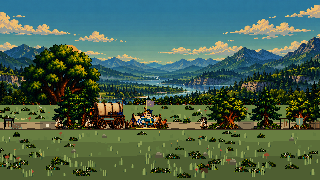
Morning 85 s
Recruit, expand, harvest, explore
Troops Free work
-
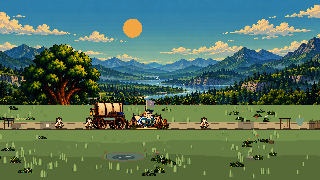
Noon 40 s
Enemy fortresses notice you. Risk of a counterattack.
Troops Free work
-
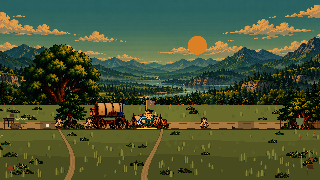
Afternoon 85 s
Last window to build. Mercenary prices rise 25%.
Troops Free work
-
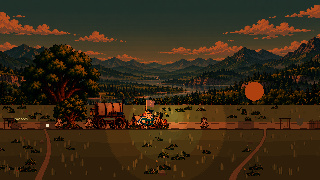
Dusk 30 s
The Rot is born at the edge of the map. A warning sounds.
Troops Back to their posts
-
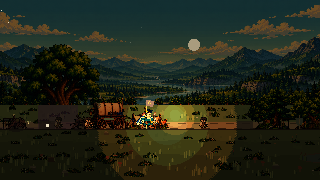
Night 105 s
Defend. Nothing gets built except by the evolved builder.
Troops Siege posts
Durations from clock.csv, text from §05. Each color is that phase's light, computed the way the game computes it; the images show the same spot at the same time as the opening.
The Rot
The Rot has a Lume, and a voice.
At the edge of the world, where the stain is born, burns its Lume — violet, and fed by everything it takes from you. From the 3rd dusk on, the stain stops at your wall and offers something — a pause, a detour, a lighter night — for a price you have to drop onto a clay plate.
Almost every offer you accept raises a debt the game never shows you as a number. Only the Lume's light tells you — and it never goes down.
Against it you have fire: the campfire, the lighthouse, the monarch's torch and the hearth at the core push back the small ones and slow down the big ones.
Give me what no longer walks.
from day 3Nothing. I only want to look.
from day 3Leave the door open.
from day 6Keep the Lume for one night.
from day 15
The Lume, night by night
- Light radius
- 154 px150 + 4 × day, cap 260
- Stain speed
- 14.9 px/s14 + 0.9 × day
- Mass, on open ground
- 5840 + 18 × day
- Arrives from
- one sidefrom day 12: both sides
The math from rot.csv, the same the game runs: three light stops, never a gradient, and a 2 px dithered edge (§80). “px” are pixels of the play plane.
The rule of two exceptions
#59386BViolet is the Rot's: the stain and the Lume.
#292520Everything else, at night, is earth.
The peoples
Conquest isn't one more resource. It's earning the right to build like them.
Each people is a closed kit: architecture, a unique troop, an economy and a defense. Two runs with the same seed play differently just from the order of conquest.
-
01 You start here
Enramados
Terrain: Ancient forest
- Builds
- In and around giant trees; platforms, ladders, balconies
- Economy
- Timber and hunting
- Defense
- Height: everything shoots from above
- Unique troop
- Canopy archer — fires from the aerial band
-
02
Portuários
Terrain: Coast
- Builds
- A huge harbor, piers, warehouses on stilts
- Economy
- Fishing and trade — the only people who earn coins at night
- Defense
- Water as a natural moat
- Unique troop
- Barge — carries 6 troops along the coast
-
03
Fenda
Terrain: Canyon
- Builds
- Carved into the rock, rope bridges between the walls
- Economy
- Stone and ore
- Defense
- Chokepoint: a single way in
- Unique troop
- Counterweight ram
-
04
Horta
Terrain: Fertile floodplain
- Builds
- Barns, greenhouses, silos, scarecrows
- Economy
- Farming — twice the yield per plot
- Defense
- Numbers: dirt-cheap troops
- Unique troop
- Sower — plants in the middle of combat
-
05
Fornalha
Terrain: Volcanic
- Builds
- Foundries, chimneys, slag walls
- Economy
- Metal and weapons
- Defense
- Permanent fire on the walls
- Unique troop
- War smith — repairs walls in combat
-
06
Sob-Raiz
Terrain: Underground
- Builds
- Tunnels, chambers, mushroom farms
- Economy
- Fungi and secrets
- Defense
- No walls — a labyrinth instead
- Unique troop
- Digger — opens passages between bands
-
07
Geada
Terrain: Glacier
- Builds
- Igloos, stone shepherd shelters, an ice palisade
- Economy
- Cold that keeps — nothing spoils
- Defense
- Frozen ground: the Rot slows down
- Unique troop
- Ice Warden — slows whoever it strikes
-
08
Bruma
Terrain: Marsh
- Builds
- Thatched reed huts and houses on stilts
- Economy
- Reeds and eels; mounts recover twice as fast
- Defense
- Mud that holds
- Unique troop
- Reed Stalker — reaches the dragonflies
Working names. What's fixed is each people's logic — the art, the troops and the balance all come from it. Text from §04; the starting people is the one whose segment the run begins on.
How to play
Three verbs, and the world around them.
No build menus, no cursors to drag. Your monarch walks back and forth along the ground line, and whatever they drop is what happens.
Drop
A coin on a vagrant recruits them. On a building site, it builds. On a wall, it raises it one step. Hold to keep dropping.
Interact
One button, always the same, always contextual: pay your companion, go down to the cellar, enter the dungeon, change bands.
Fight
Each monarch strikes their own way — the sword, quick blows, arrows — and has an ability: the Vigil, the Bard's song or the mark.
| Action | Keyboard and mouse | Gamepad | Touch |
|---|---|---|---|
| Walk | A D or ← → | D-pad ← → or left stick ← → | The stick, on the left |
| Run (hold; uses stamina) | Shift | L3 | RUN, held |
| Drop a coin | Space | A | COIN (hold: keep dropping) |
| Interact and pay | E | X | INTERACT |
| Attack (hold to repeat) | F or left click | RB | The weapon, beside COIN |
| Monarch ability | R or right click | RT | The ability, or tap the creature |
| The state of the kingdom | Tab | Y | IMPULSES: hold, drag, let go |
| Look to the sides | Q Z | right stick ← → | PIN, then drag the world |
| Pause and options | Esc | Menu | The pause button, up top |
Read from project.godot's input map on every publish.
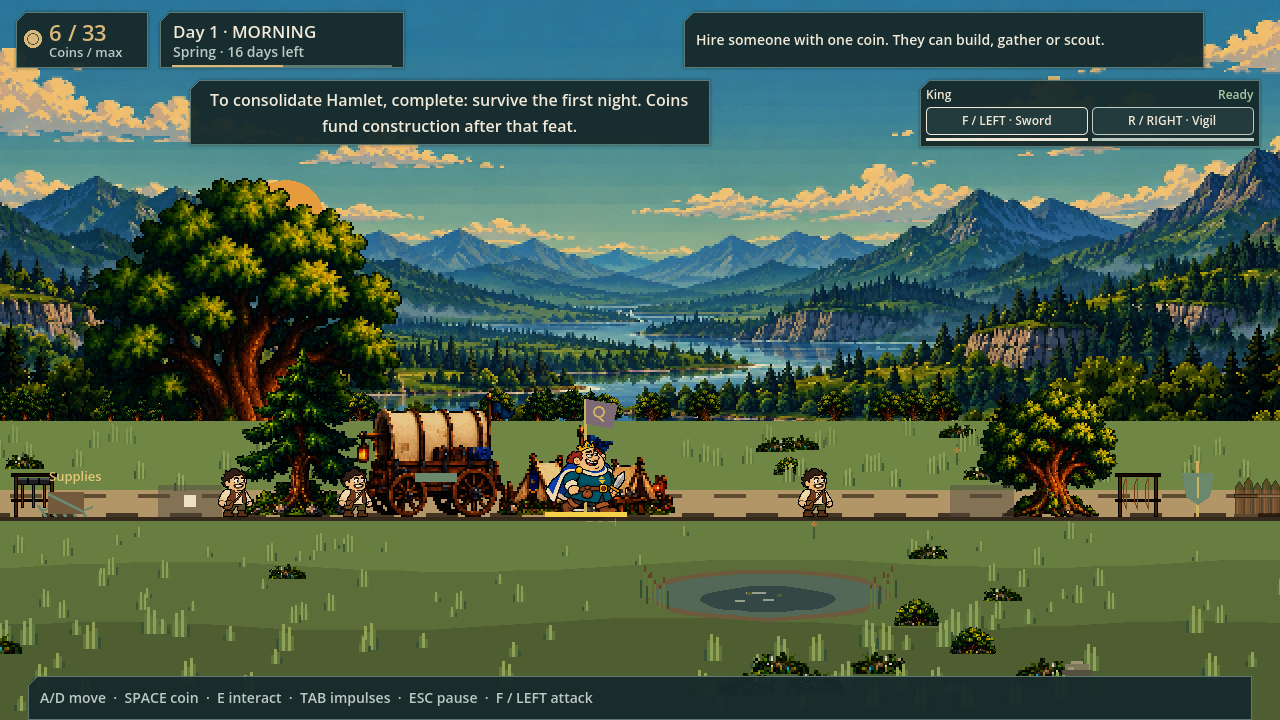
f3efeac, on October 7, 2026, with the game's interface. The published game (0c35177) no longer looks like this: these images predate it and will be retaken after the next visual review.Progress
A game built in the open, one ticket at a time.
These numbers are recounted from the repository on every publish — none is typed by hand. This version is commit 0c35177.
- 127 done
- 22 partial
- 40 to do
The roadmap: nine phases, each with an exit criterion
-
0 · Foundation 1 month
Repo, CI, CLAUDE.md, bands, camera, GameClock, the scale decision
Exit criterion A sprite walks through the three bands and CI is green
13 of 16 tickets
-
1 · Playable core 3 months
Physical coins, recruiting, walls, archers, the Rot, one night — scenery in flat color blocks, with the characters already animated on top. On Saturdays, the Phase 2 scenery starts (§22).
Exit criterion Surviving 10 days is possible and not trivial, and the poster scene is finished
17 of 17 tickets
-
2 · Vertical slice 3 months
One complete people with final art (7 buildings, 3 creatures, 5 walls), 1 class, 3 crafts, 1 fortress
Exit criterion You play 10 days and want to play the 11th — the test that decides the project
0 of 1 tickets
-
3 · The second layer 2 months
Playable underground, dither reveal, secrets, first journal
Exit criterion Minute 10 of §25 works with strangers
Not started
-
4 · Public demo 2 months
Tuned onboarding, sound, options, Steam page, web build
Exit criterion Page published. Wishlists piling up.
Not started
-
5 · Next Fest 3 months
Demo at Next Fest, accessibility, Steam Deck, telemetry
Exit criterion More than 5,000 wishlists. If not, stop and diagnose.
Not started
-
6 · Depth 6 months
Classes 2–4, evolutions, mounts, greed, boosts, succession, debt
Exit criterion A full 30-day run with no missing systems
Not started
-
7 · Content and world 6 months
The 6 peoples, procedural generation, 12 journals, chaotic biomes, 2 epilogues
Exit criterion Launch. Or Early Access here.
Not started
-
8 · Multiplayer 4 months
Split screen, then online
Exit criterion Post-launch. Cut without regret if needed.
Not started
From §33. You move on when the criterion passes, not when it feels ready.
The latest decisions
- ADR 0084Cenários nativos em camadas e revisão física
- ADR 0083Os animais e as criaturas animados do dono entram no jogo
- ADR 0082Corrigir os contratos observados na auditoria mestre
- ADR 0081Os cenários em camadas do dono entram no jogo
- ADR 0080Primeiro contacto claro e trabalho a pedido
- ADR 0080Correções da auditoria de 11/10/2026
Every change of course is written down in an ADR, with the why. These are the most recent, read from docs/adr/ — in Portuguese, as in the repository.
All 189 tickets, by track
Ticket titles are in Portuguese, as in the repository.
Phase 0 · Foundation 13/16: 13 done, 1 partial, 2 to do
Phase 1 · Playable core 17/17: 17 done, 0 partial, 0 to do
Phase 2 · Vertical slice 0/1: 0 done, 1 partial, 0 to do
Greybox 27/28: 27 done, 1 partial, 0 to do
Part XIII · the lantern and the harvest 7/11: 7 done, 3 partial, 1 to do
Playable classes 1/1: 1 done, 0 partial, 0 to do
Direct combat 1/1: 1 done, 0 partial, 0 to do
Playable monarchs 17/35: 17 done, 0 partial, 18 to do
From clearing to kingdom 13/30: 13 done, 8 partial, 9 to do
Content 1/1: 1 done, 0 partial, 0 to do
Documentation 1/1: 1 done, 0 partial, 0 to do
Art 2/6: 2 done, 0 partial, 4 to do
Scenery 0/3: 0 done, 3 partial, 0 to do
Naming 0/1: 0 done, 0 partial, 1 to do
Publishing 5/5: 5 done, 0 partial, 0 to do
Gameplay audit 5/5: 5 done, 0 partial, 0 to do
Campaign continuity 2/12: 2 done, 5 partial, 5 to do
Interface 8/8: 8 done, 0 partial, 0 to do
Panel decisions 7/7: 7 done, 0 partial, 0 to do
See the tickets as a list
| Ticket | Title | State |
|---|---|---|
| F0-00 | Repositório do dia zero: as ondas 1 e 2 da §68 | Done |
| F0-01 | Criar o projeto Godot 4.6 com as definições do §19 | Done |
| F0-02 | Git LFS para *.aseprite e art/**/*.png | Partial |
| F0-03 | AGENTS.md e os primeiros ADRs | Done |
| F0-04 | Instalar o gdUnit4 e o workflow de CI | Done |
| F0-05 | Band: enum, planos e a matriz de colisão | Done |
| F0-06 | GameClock e o ClockData (prompt 1 da §29) | Done |
| F0-07 | EventBus com os sinais do §46 | Done |
| F0-08 | Câmara com lookahead e limites de região | Done |
| F0-09 | Spike: decidir a escala e fechar a ADR 0001 | To do |
| F0-10 | Cena de teste: um sprite anda nas três faixas | Done |
| F0-11 | Registry e boot.tscn | Done |
| F0-12 | RngService: os seis fluxos, snapshot e restore | Done |
| F0-13 | SaveService: escrita atómica e três slots | Done |
| F0-14 | UnitView com cinco slots e o shader da paleta | Done |
| F0-15 | Spike: importar arte do Aseprite e fechar a ADR 0010 | To do |
| F1-01 | Moeda física: largar, arco, queda, apanhar, saco | Done |
| F1-02 | UnitData e as seis unidades do §07 | Done |
| F1-03 | UnitSystem com arrays paralelos e time-slicing | Done |
| F1-04 | Recrutar um vagabundo por uma moeda; ele segue-te | Done |
| F1-05 | JobBoard (prompt 4 da §29) | Done |
| F1-06 | Muro: cinco níveis, dois caminhos, slots de contacto | Done |
| F1-07 | Arqueiro: alcance, precisão 0,34 em campo e 1,0 em torre | Done |
| F1-08 | RotSystem (prompt 2 da §29) | Done |
| F1-09 | Criaturas: Rastejante, Alado, Bruto e a tabela de invocação | Done |
| F1-10 | Economy (prompt 3 da §29) e a curve.tres | Done |
| F1-11 | Plantação, pesqueiro e galinheiro com os valores do §06 | Done |
| F1-12 | Moral e fuga com o raio do rei | Done |
| F1-13 | CanvasModulate por faixa, animado pelo GameClock | Done |
| F1-14 | Save e load do estado de src/sim/ com save_version | Done |
| F1-15 | Cenário de combate noturno para afinação | Done |
| F1-16 | Afinar até sobreviver dez dias ser possível e não trivial | Done |
| F1-17 | Arte da mancha: a Podridão e a candeia | Done |
| ART-01 | A primeira personagem real em cinco slots | To do |
| ART-02 | A paleta mestra e o LUT | To do |
| ART-03 | As seis camadas de parallax com teto de valores | To do |
| ART-04 | Rostos e expressões: o catálogo do §60 | To do |
| GB-01 | Greybox do segmento zero | Partial |
| GB-02 | Greybox dos seis biomas | Done |
| GB-03 | Regras de densidade medidas no greybox | Done |
| GB-04 | O passo do §21: a região atravessa-se em 40–60 s | Done |
| GB-05 | O preço daquilo em cima de que estás | Done |
| GB-06 | Largar em contínuo, que o §24 já mandava | Done |
| GB-07 | O rei não fica preso em combate | Done |
| GB-08 | O golpe que se vê | Done |
| GB-09 | A sombra de contacto da moeda | Done |
| GB-10 | O render interpola, e o rei deixa de andar aos solavancos | Done |
| GB-11 | O gatilho direito, num comando | Done |
| GB-12 | A câmara livre pelo rato na margem | Done |
| GB-13 | Pausa e opções: desligar o tremor e os clarões | Done |
| GB-14 | O sinal da passagem, onde o Verbo 2 pega | Done |
| GB-15 | Os glifos do comando que se está a usar | Done |
| GB-16 | A derrota diz a verdade, e dá um jogo novo | Done |
| GB-17 | O amanhecer que se vê chegar | Done |
| GB-18 | O sol e a lua dizem a hora | Done |
| GB-19 | O pequeno bounce da moeda | Done |
| GB-20 | A cara de quem está ferido | Done |
| GB-21 | As tropas saem dos postos atrás da luz | Done |
| GB-22 | As legendas de som | Done |
| GB-23 | A silhueta fantasma a piscar | Done |
| GB-24 | A duração do dia, ao ritmo de quem joga | Done |
| GB-25 | O controlo de contraste | Done |
| GB-26 | Os modos para daltonismo | Done |
| GB-27 | O painel fala por chave | Done |
| GB-28 | O idioma escolhe-se na pausa | Done |
| NB-01 | Bíblia de nomes e a escolha do nome do jogo | To do |
| CD-01 | A base de dados de conteúdo, uma tabela por sessão | Done |
| XIII-01 | §80 · O preto na paleta e a noite castanha | Done |
| XIII-02 | §74 · O termo dos Amargueiros na massa | Done |
| XIII-03 | §74 · O Amargueiro e a candeia, completos | Done |
| XIII-04 | §75 · A Oferta e a Dívida da Candeia | Done |
| XIII-05 | §76 · O Nome | Done |
| XIII-06 | §78 · A Colheita | Partial |
| XIII-07 | §77 · Os dez capítulos | Partial |
| XIII-08 | §79 · Os doze diários e os três epílogos | Partial |
| XIII-09 | §81 · Som: o cante, os motivos e a encomendação | To do |
| XIII-10 | §83 · Os primeiros vinte minutos | Done |
| XIII-11 | §84 · Os catorze testes de design e as seis linhas de risco | Done |
| PUB-01 | O jogo passa a jogar-se no browser | Done |
| PUB-02 | O site passa a ser a página do jogo | Done |
| F2-01 | A classe do Monarca: a aura e a evolução | Partial |
| AUD-01 | Integridade da simulação: a moeda, o muro, a torre, o rei e o save | Done |
| AUD-02 | A economia verdadeira: o que o CI afina é o que o jogo corre | Done |
| AUD-03 | A noite legível e com gestos | Done |
| AUD-04 | As faixas: o subsolo como expedição e o Alado com alvo | Done |
| AUD-05 | Uma campanha mínima: sucessão, fim de região e decay | Done |
| CONT-01 | Transição durável: o legado como transação | Done |
| CONT-02 | Memória da campanha: o que atravessa e o que fica | Partial |
| CONT-03 | Snapshot do trabalho: o Staffing no save | Done |
| CONT-04 | Transições sem prisão: sucessão e escoras | Partial |
| CONT-05 | Medição fiel da partida | Partial |
| CONT-06 | Manutenção com custo marginal | To do |
| CONT-07 | Duas economias de conversão válidas | To do |
| CONT-08 | Abertura e controlo completos | Partial |
| CONT-09 | Sinais de ação e ameaça | To do |
| CONT-10 | Duas regiões autoradas | To do |
| CONT-11 | Um povo, uma escolha completa | To do |
| CONT-12 | Evidências e estado derivados | Partial |
| PUB-03 | Decisões compreensíveis no painel | Done |
| PUB-04 | O site mostra o jogo de hoje | Done |
| UX-01 | Reformular a pausa e corrigir o corte visual | Done |
| ART-TEMP-01 | Assets gratuitos temporarios para testar a gameplay | Done |
| QP-01 | Aplicar as onze respostas restantes do painel | Done |
| CLASSES-01 | Três classes na primeira escolha | Done |
| COMBAT-01 | Combate direto das classes | Done |
| UX-02 | Jogar com os dedos: os controlos por toque | Done |
| UX-03 | A alavanca solta, o FIXAR e o ecrã inteiro | Done |
| UX-04 | O CORRER no toque e as obras com sprite | Done |
| UN-00 | Consolidar as regras dos monarcas e a ADR | Done |
| UN-01 | Esquema de monarcas e companheiros | Done |
| UN-02 | Autoridade por reino e por pessoa | Done |
| UN-03 | Vínculo de companhia | Done |
| UN-04 | Seleção imperial e autoria inicial | Done |
| UN-05 | Retirar o controlo de tropas | Done |
| UN-06 | Migração das campanhas antigas | Done |
| UN-07 | Generalizar a morte e a sucessão | Done |
| UN-08 | Despacho do combate e da habilidade | Done |
| UN-09 | A Imperatriz Nia e os números de bancada | Done |
| UN-10 | O Bardo real pago | Done |
| UN-11 | Conversão e hostilidade | Done |
| UN-12 | Promoção e evolução de Nia | Done |
| UN-13 | O Imperador Arqueiro e a aljava | Done |
| UN-14 | O escudeiro que fornece flechas | Done |
| UN-15 | O sangramento | Done |
| UN-16 | Encontros e roster imperial | To do |
| UN-17 | Troca imperial transacional | To do |
| UN-18 | Diplomata universal sob IA | To do |
| UN-19 | Tesouro local e defesa na ausência | To do |
| UN-20 | Incursões com Diplomata | To do |
| UN-21 | Captura, resgate e dívida | To do |
| UN-22 | Alvo de unidade e de obra, e conquista | To do |
| UN-23 | Governo inimigo e assimilação | To do |
| UN-24 | Viagem da comitiva, montarias e sítios | To do |
| UN-25 | Ofícios, evolução e produção animal | To do |
| UN-26 | Pontes, torres e um evento de bioma | To do |
| UN-27 | Lore e apresentação dos encontros | To do |
| UN-28 | O primeiro ciclo e a acessibilidade | To do |
| UN-29 | Coop local | To do |
| UN-30 | Dois reinos e a vitória | To do |
| UN-31 | Spike e integração de rede | To do |
| UN-32 | O herdeiro neutro, caro, e a chave da troca | To do |
| UN-33 | O quarto imperador e a escudeira que dança | To do |
| UN-34 | O escudeiro evoluído dispara flechas | Done |
| QP-02 | As respostas do painel de 02 e 03/10/2026 | Done |
| QP-03 | O baú da sala secreta | Done |
| QP-04 | O refinamento da jogabilidade de 03/10/2026 | Done |
| QP-05 | A caça a sério | Done |
| RG-00 | O contrato do plano do reino | Done |
| RG-01 | O contrato da sede | Done |
| RG-02 | O pacote e o início | Done |
| RG-03 | A escada da sede, do Acampamento à Fortaleza | Done |
| RG-04 | O contexto do núcleo | Done |
| RG-05 | Empregos e reposição | Partial |
| RG-06 | A economia de trajetória | To do |
| RG-07 | A primeira defesa aérea | Partial |
| RG-08 | A interface do benefício e do compromisso | Partial |
| RG-09 | Frentes e refúgios | To do |
| RG-10 | Expansão e acampamentos | To do |
| RG-11 | A Vila Fortificada e a Fortaleza | Partial |
| RG-12 | O primeiro posto | To do |
| RG-13 | A primeira rota física | To do |
| RG-14 | A Capital | To do |
| RG-15 | Integração e ausência | To do |
| RG-16 | Arte por estágio e por povo | Partial |
| RG-17 | Migração | Partial |
| RG-18 | Desempenho e mobile | Partial |
| RG-20 | Uma clareira, prados de caça e floresta de exploração | Done |
| RG-19 | Construções e recrutamento acompanham a expansão | Done |
| QP-06 | A caça longe do reino | Done |
| RG-21 | Recrutamento por corrida, fundação na lareira e cidade dentro das muralhas | Done |
| RG-22 | A Última Carroça: relatório completo e decisões atuais do painel | Done |
| RG-23 | Adaptar relatório mestre e fundação livre Solo | Done |
| RG-24 | Identidade territorial e despertar social | To do |
| RG-25 | Servidor autoritativo e modos online | To do |
| RG-26 | A floresta como território | Done |
| RG-27 | O subsolo tem chão para além da escada | Done |
| QP-07 | Usar o Painel no desktop e no mobile | Done |
| UX-05 | HUD legível e compacta no telemóvel | Done |
| DOC-01 | Consolidar o dossiê com o painel e as referências territoriais | Done |
| ART-RENEWAL-01 | Renovacao visual do reino | Done |
| RG-28 | O território decide o que se levanta | Done |
| UX-08 | Atlas do Império: a ficha do sítio e uma só linguagem na HUD | Done |
| CV-01 | Cenários: diagnóstico reproduzível e o contrato dos planos | Partial |
| PUB-05 | Primeiro contacto, desempenho e resiliência do site | Done |
| UX-09 | Explicações breves ao parar e pausa móvel rolável | Done |
| UX-10 | Toques da HUD sem conflitos entre dedos e menus | Done |
| CV-02 | Cenários em camadas: os reinos e as transições do dono no jogo | Partial |
| RG-29 | Correções da auditoria mestre de 09/10 | Partial |
| CV-03 | Animais e criaturas animados: os pacotes de 64 × 64 do dono no jogo | Partial |
Questions
What people usually ask.
Can I play it now?
When and where does it come out?
Is Empire the final name?
Which languages?
Does the site or the game collect data?
Who's making this?
Is it open source?
Empire
Ready for your first kingdom?
Explore at your own pace. The next story starts with you.